
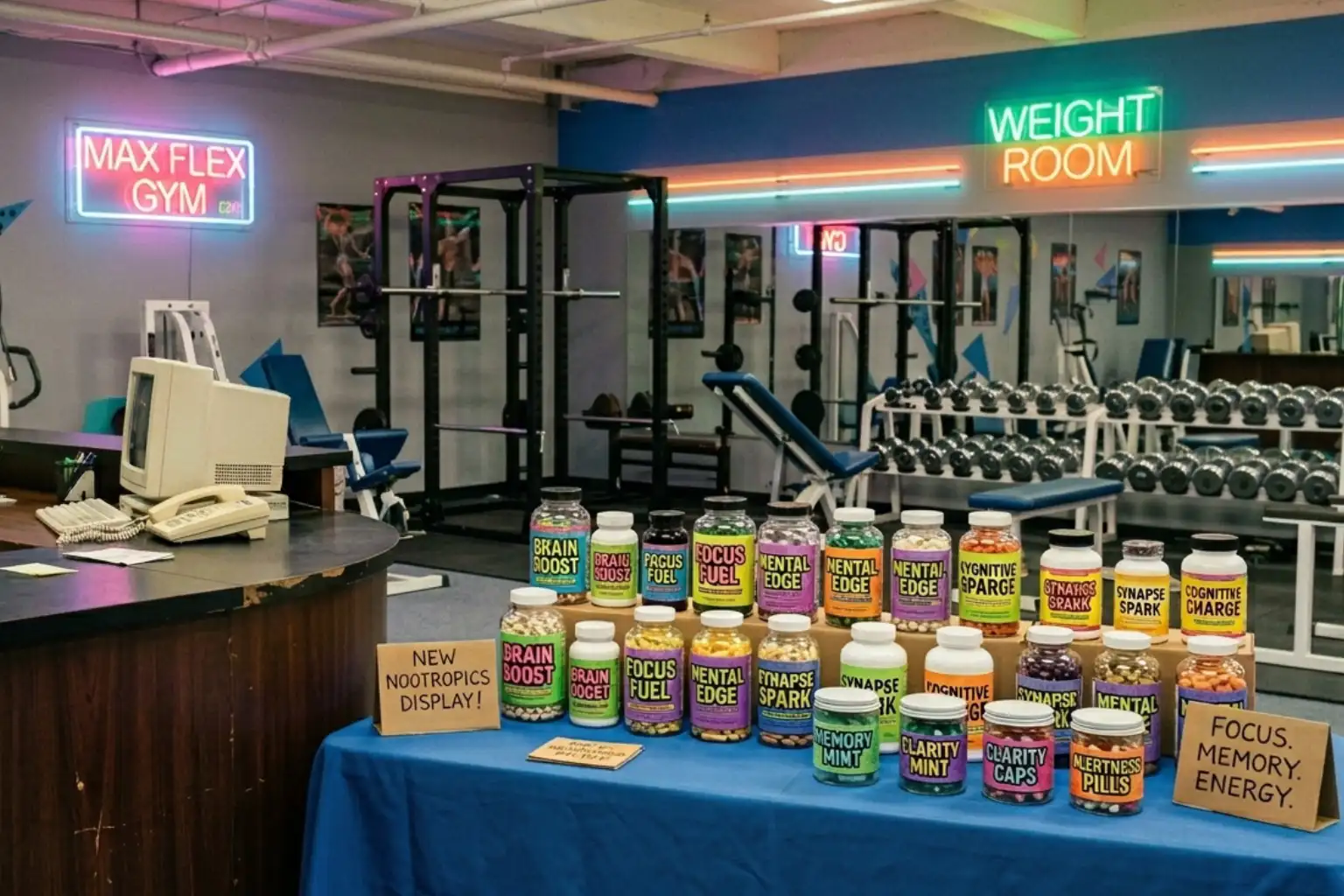

Nootropic supplements are not smart pills, and nothing in a tub will turn a scattered session into a flawless one. Plenty of marketing still makes that promise, which leaves lifters wondering whether they are paying for real focus or just a clever label.
The honest answer sits in the middle. A small group of ingredients has decent evidence for alertness and attention, a few have patchy results and some are mostly hype. This guide sorts them into those three groups so you know what to expect from nootropic supplements before you spend a cent.
What nootropic supplements actually do
Nootropic supplements are ingredients taken to support mental performance, mainly attention, alertness and reaction time. In the gym that means staying switched on between sets, ignoring your phone and keeping your technique tidy when fatigue builds.
Think of your brain as a phone with too many apps running. Some ingredients close a few apps so the battery lasts longer. Others just turn up the screen brightness for a while. Knowing which is which saves you money and keeps your expectations realistic.
Nootropic supplements will not add weight to the bar. They may help you train with sharper attention, and that is a very different promise.
Which nootropic supplements have the best evidence?
Caffeine and L-theanine
Caffeine sits at the centre of most nootropic supplements because it blocks the signals that tell your brain you are tired. L-theanine is an amino acid found in tea that many lifters pair with it for a smoother and less edgy feel.
A 2014 systematic review and meta analysis of 11 placebo controlled studies found moderate effects in favour of the combination for alertness and attention switching accuracy during the first two hours after a dose. One trial linked 97 mg of L theanine with 40 mg of caffeine to better focus on a demanding task. More recently, a double blind study of sleep deprived adults found that 200 mg of L theanine with 160 mg of caffeine improved accuracy and reaction time.
There is a catch. Examine points out that the studies are small, dose response research is lacking and the effect on exercise performance specifically is unclear. Examine also notes that theanine may soften some unwanted caffeine effects, such as raised blood pressure and disrupted sleep, without cancelling the attention benefits.
Alpha-GPC
Alpha-GPC is a choline containing compound that raises acetylcholine, a brain messenger linked to learning and memory. The results so far are mixed.
A 2015 ISSN conference poster tested 200 mg and 400 mg of alpha GPC against 200 mg of caffeine and a placebo in 20 people. It found no statistically significant benefit for mood, cognition or physical performance, partly because individual responses varied so much. Vertical jump peak power was numerically higher with both alpha GPC doses (8.5% and 7.5%), which keeps researchers interested.
A 2024 study in the journal Nutrients reported better Stroop test scores in young healthy men after a single dose of a branded alpha GPC. That is encouraging, but you want independent replication before treating it as settled.
L-tyrosine and Citicoline
The ISSN position stand on energy drinks reports some supportive evidence that L-tyrosine helps protect thinking during acute stress, but no effect on performance capacity. Citicoline has even less to offer, with support only at very large doses and in animal work. The same review found no known effects for either ingredient at the dosages used in energy drinks and shots.
| Ingredient | What it may help | Strength of evidence | Doses used in research |
|---|---|---|---|
| Caffeine with L-theanine | Alertness and attention switching | Moderate but small studies | 40 to 160mg caffeine with 97 to 200mg theanine |
| Alpha GPC | Mental sharpness and reaction speed | Mixed | 200 to 400mg in one trial |
| L-tyrosine | Thinking under acute stress | Some support, no performance effect | 150mg acute to 2g per day in ISSN reviewed studies |
| Citicoline | Memory and focus | Weak at typical label doses | Very large doses in research |
Can nootropic supplements really improve focus in the gym?
Possibly, in modest ways. Caffeine does most of the heavy lifting and is the best backed ingredient for both focus and training. The rest of a typical stack adds smaller effects for some people and nothing for others.
Most trials also measure computer tasks in a lab, not your fourth set of squats. That means the gym translation is an educated guess rather than a guarantee.
If nootropic supplements work for you, you will notice less mental drag when you walk in after a long day. You may also find your concentration holds steadier through the last working sets. If you feel nothing, that is a legitimate result and a sign to save your money.
Who may benefit most from nootropic supplements
These groups tend to notice the biggest difference.
- Early morning lifters who train before their brain has fully switched on.
- Shift workers or anyone running on short sleep.
- Busy professionals who train after a full day of meetings.
- Lifters who want a calmer feel than straight caffeine gives them.
Take extra care if you are sensitive to caffeine, pregnant, breastfeeding, taking medication or training late in the evening, because stimulants can disrupt sleep. Always consult a healthcare professional before starting new supplements.
How to use this in your routine
A simple testing plan beats guessing. Follow these steps before you commit to any product.
- Fix the basics first. Sleep, a decent meal and enough water will lift your focus more than any tub.
- Keep it simple. Start with your usual caffeine and add L-theanine at a similar or higher amount, because that is the pattern in the studies above.
- Time it properly. Take it about an hour before training, since studies picked up benefits roughly 60 to 90 minutes after dosing.
- Track it for two weeks. Score your focus out of 10, note your distractions and count the sets you finish with clean technique. Change nothing else.
- Add up your total caffeine. Count coffee, pre workout and energy drinks together, and skip late arvo doses that cost you sleep.
- Keep what works. If you feel jittery, anxious or flat, stop and reassess before adding more nootropic supplements.
Key Takeaways
Here is what to remember before you buy.
- Caffeine with L-theanine has the strongest evidence among nootropic supplements, though the studies are small.
- Alpha GPC, L-tyrosine and citicoline have mixed or limited results, so treat bold claims with caution.
- Lab results may not carry over fully to a real training session.
- Test one change at a time for two weeks and judge it by your own notes.
Final Thoughts
Nootropic supplements can help you feel sharper in the gym, but they work best as a small boost on top of good sleep, food and training habits. No capsule will fix a week of five hour nights or a skipped lunch. If your basics are in place, though, the right ingredient can take the edge off mental fatigue and help you stay locked in when your session gets tough.
The best evidence points to a simple caffeine and L theanine combination, and you can test it cheaply without a complicated stack. Alpha GPC, tyrosine and the rest of the ingredient list have mixed or limited results so far. That does not make them useless, but it does mean you should treat bold marketing claims with a healthy dose of scepticism and read the label before you buy.
Run your own two week experiment and change one thing at a time. Score your focus, note your distractions and count the sets you finish with clean technique. Your notes will tell you more than any product page, and they will show you quickly whether a supplement deserves a place in your daily supplement routine.
If you have a medical condition, take medication or are sensitive to caffeine, check with your doctor or pharmacist before you start. Then trust the results, keep your total caffeine in check and keep your focus on the work under the bar.
